The shortlist phase is where most Jira time tracker evaluations go wrong.
A Jira admin filters the Atlassian Marketplace for time tracking, opens five promising Jira time tracker app listings, and every overview page mentions worklogs, reports, and dashboards. Timesheets. Timers. Rollups. Billing. Resource planning. Status analytics.
Then a project manager asks the question that actually drives the install:
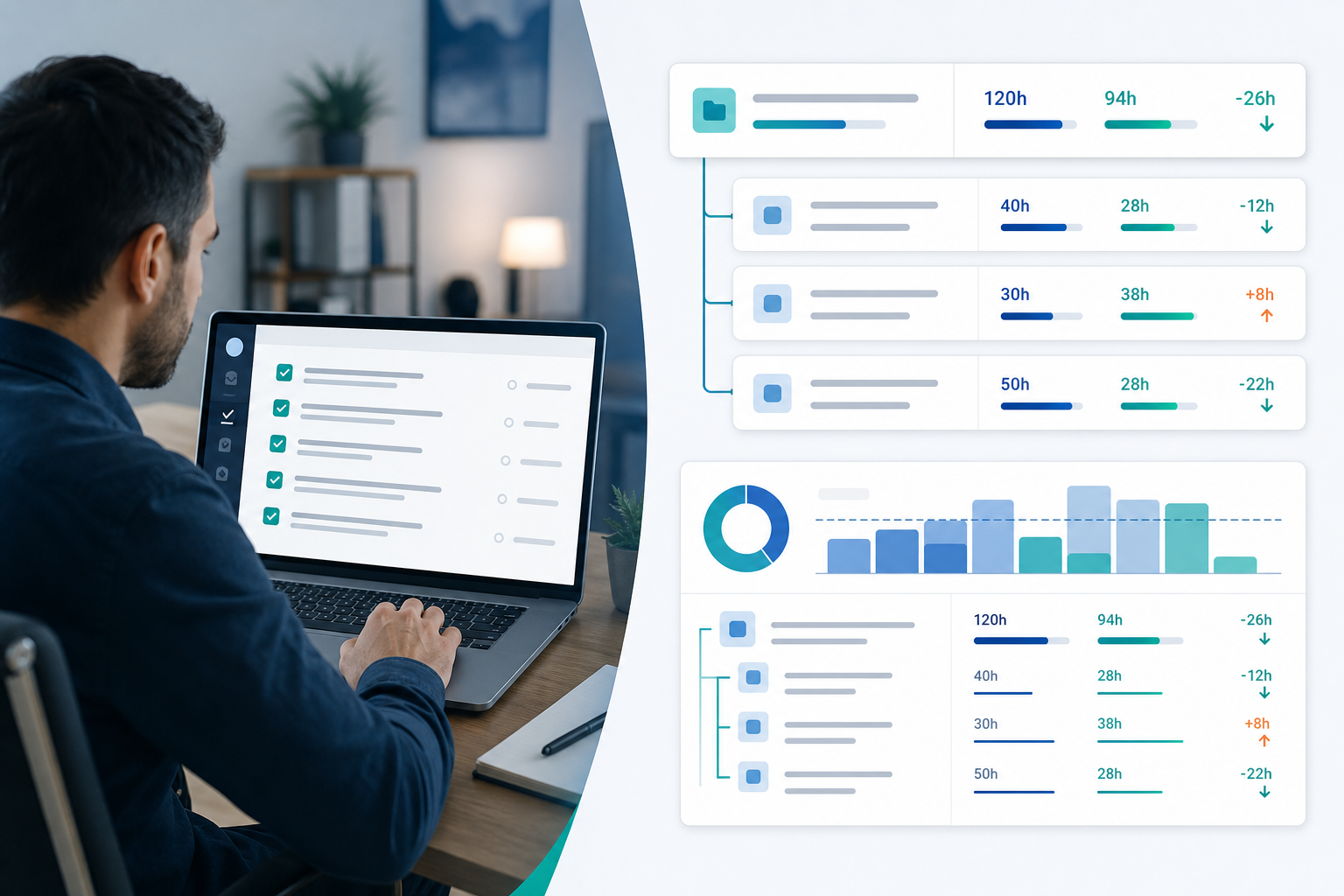
"For epic DEL-20, what did we estimate, what have we logged, where is the variance, and which child issues explain the total — without exporting to Excel again?"
That question does not map cleanly to every listing. Some apps govern how people submit hours. Some automate capture with timers and calendars. Some plan team capacity. Some measure workflow aging. A smaller set focuses on live rollups of native Jira time fields.
Installing the wrong category is how teams adopt a timesheet suite for a rollup gap — or a rollup panel when finance needed approvals and locked periods.
These eight questions are the tracker shortlist gate: logging, rollups, permissions, exports, and admin fit. For data handling, scale, procurement signals, and a fuller provider review, continue with Before you install a Jira time tracking app, ask these 12 questions. If your team has not separated timesheets from hierarchy reporting yet, start with Jira timesheets vs Jira time tracking.
Quick Answer
If you only have time to ask four questions before a trial:
- Question 1 — Which reporting job is this tracker built for?
- Question 3 — How does it roll up the hierarchy you actually report on?
- Question 5 — Does it respect worklog visibility for non-admin viewers?
- Question 8 — Can a second manager reproduce the same totals on real data?
When a finalist passes those four, run the full eight before procurement.
Before You Filter Marketplace Results
Three prep steps save trial time:
- Name the recurring report. Sprint review packet, client steering update, billing close, or capacity plan — pick one.
- Write your estimate rule. For example: "Original estimate lives on the parent story; subtasks explain execution unless the parent estimate is empty." See original estimate vs time spent in Jira once scope is locked.
- Check native paths first. Jira already stores worklogs and estimates. Atlassian supports exporting search results to CSV and Excel. If the only gap is hierarchy math, you may need a rollup tracker — not a full timesheet platform.
Question 1: Which Reporting Job Is This Tracker Built For?
Write the question you need answered every week, not the feature list on the Marketplace page.
Common jobs include:
- Live rollups: current epic or project estimate, logged time, variance, and child-issue explanation
- Timesheets and approvals: who submitted time, who approved it, and can the period be locked?
- Time capture and cost: timers, calendars, billable hours, rates, and billing-period controls
- Resource planning: capacity, allocations, leave, utilization, planned vs actual
- Status analytics: where work waits, lead time, cycle time, and workflow bottlenecks
Those are different Atlassian Marketplace time tracking products wearing similar labels.
Atlassian's time tracking documentation says Jira can show logged time and remaining time on work items. Many teams still add a Jira worklog app because native views do not answer their recurring stakeholder question in one place.
Start with the report you keep rebuilding. The right shortlist follows from that job — not from search ranking.
Question 2: Where Will People Actually Log Work?
Logging workflow is an admin decision with rollback consequences.
"If we uninstall this app in six months, where do our worklogs live — and will our dashboards still make sense?"
Ask every finalist:
- Does the app read native Jira worklogs and time fields?
- Does it require users to log through the app instead of Jira's default panel?
- Does it become the time tracking provider, changing where time is captured or validated?
- If you uninstall later, where do the worklogs live?
- Does captured time sync back to Jira fields your dashboards and exports already use?
Atlassian's time tracking administration documentation notes that Marketplace apps can extend Jira's capabilities and that third-party providers may store data with the app developer.
Extension apps often mean lower process change. Provider replacement can be right for billing governance — but it is a bigger migration story. Match the logging model to how your team works today, not how a demo logs a single task.
Question 3: How Does It Roll Up Across the Hierarchy You Report On?
Hierarchy rules make or break Jira worklog reporting.
Teams estimate and log at different levels:
- Parent story carries the budget; subtasks carry execution detail
- Only lowest-level issues carry estimates
- Epics are containers; real hours live on stories and bugs underneath
Clarify with the vendor or in sandbox:
- Which issue types and levels are included: subtask, story, epic, initiative, project, saved filter?
- Does the app roll up linked issues, or only parent-child trees?
- How does it handle parent and child estimates when both are populated?
- Are done issues, moved issues, or missing estimates included or excluded?
- Does it match how your team reports in sprint reviews and client updates?
Atlassian documents native limits such as subtask estimates not appearing in sprint reports and planning rollups behaving differently in Jira Plans than in operational issue-level reports. Your tracker should declare inclusion rules clearly enough that a second manager can audit them.
Question 4: Which Time Fields Appear at the Level You Report On?
Budget conversations need more than logged hours.
At minimum, clarify support for:
- Original estimate (baseline)
- Time spent (logged work)
- Remaining estimate (forecast)
- Spent variance:
time spent - original estimate - Forecast variance:
time spent + remaining estimate - original estimate
Some rollup trackers emphasize estimate, logged time, and spent variance. Others focus on billable hours, cost rates, or status duration instead. If your process depends on remaining estimate or forecast variance at epic or project scope, confirm the app surfaces those fields — not only on individual issues.
Also confirm whether the app respects your board's estimation statistic (time vs story points) or assumes time-based fields everywhere.
Question 5: Does It Respect Jira Permissions and Worklog Visibility?
Worklog data is sensitive.
Users need appropriate Jira permissions to log and view time. For any candidate app, verify:
- Do viewers only see worklogs they would see in native Jira?
- Does the app expose totals that leak restricted child issues?
- Do project-level and global permissions behave as expected for contractors, clients, or shared dashboards?
- If the app adds gadgets or shared reports, do hidden gadgets stay hidden for unauthorized viewers?
A rollup that looks correct for an admin but wrong for a project manager often fails permission alignment, not math. Test with a non-admin viewer during trial — not only with your own admin account.
Question 6: Can You Export Stakeholder-Ready Output Without Friday Spreadsheet Cleanup?
The recurring report often leaves Jira even when the tracker lives inside Jira.
Check:
- Export formats: CSV, Excel, PDF, API, dashboard feed
- Whether on-screen totals match exported files
- Whether exports include the child breakdown your stakeholder expects
- Whether you can produce a sprint review or client update without manual cleanup every cycle
Atlassian's native search export path is the baseline many teams outgrow. A useful tracker should beat that baseline for your named report — not just add another screen with the same missing hierarchy.
Question 7: What Admin Setup, Scopes, Security, and Maintenance Does It Create?
Marketplace screenshots show the happy path. Admins live in configuration and permissions.
Ask:
- Is there a zero-config path, or are teams, calendars, billing periods, accounts, or provider settings required on day one?
- Who owns saved filters, report definitions, and export templates after install?
- Does the app need workflow, custom field, or screen changes?
- Are Cloud and Data Center setup paths equivalent for your hosting model?
- What OAuth scopes, Connect permissions, or Forge scopes does the install prompt request?
- Does the app read all projects or only selected ones?
Security and privacy checks for finalists:
- Marketplace Privacy & Security tab
- Vendor privacy policy and Data Security & Privacy statement
- Whether the app becomes the time tracking provider or reads native worklogs in place
- Whether data is stored or processed outside Atlassian-hosted infrastructure — only as the vendor documents it
- Cloud Fortified or Bug Bounty participation, where visible — as signals to investigate, not guarantees
- SOC 2, ISO, GDPR, or DPA claims only when explicitly published by the vendor
Atlassian tells admins to review vendor statements because third-party time tracking providers may store data with the app developer. Do not treat "Runs on Atlassian" or trust badges as proof your procurement questions are answered.
Also read Marketplace metadata at the time you evaluate: trial availability, support links, last updated version, hosting tab match (Cloud vs Data Center), and visible install or review signals — noting these change. Word pricing and install counts cautiously: "The listing showed at the time of research..." or "Verify current pricing on the Marketplace page."
Lightweight rollup trackers may install quickly. Timesheet, billing, and resource-planning suites often need a rollout plan, permission model, and training — budget that before you buy.
Question 8: Can a Second Manager Reproduce the Trial Report on Real Data?
The final gate is reproducibility.
Pick one recurring report — sprint review, client update, or budget check — and run it twice: once with the admin who installed the app, once with a project manager who did not configure it. Both should reach the same totals using documented scope rules.
Example trial scope:
Open epic DEL-20 (or your largest real epic), confirm estimate, logged time, and variance match agreed formulas, and export the same child breakdown the PM sends to clients every month.
Copy this checklist into evaluation notes:
- Scope matches a real epic, sprint, or client slice — not a demo project
- Estimate, logged, remaining (if required), and variance match agreed formulas
- Child breakdown explains the total
- Exports match on-screen numbers
- Permissions hold for non-admin viewers
- Performance is acceptable on your largest real hierarchy
- Hosting tab on the Marketplace listing matches your environment
- A second manager can reproduce the report without private configuration knowledge
If only one person knows the secret filter or setup sequence, you have bought a personal shortcut — not team reporting.
Five Tracker Categories Buyers Confuse
Use this as a category map, not a ranking. Verify current Marketplace listings before you shortlist any named example.
| Category | Typical buyer question | Example direction | Verify carefully |
|---|---|---|---|
| Live rollups | "What is the current epic or project time total with child breakdown?" | Focused rollup apps | Hierarchy rules, variance fields, export quality |
| Timesheets and approvals | "Can we submit, approve, and lock time?" | Timesheet suites | Provider model, permissions, billing period behavior |
| Time capture and cost | "Can we log time faster and report billable hours?" | Timer and cost apps | Calendars, billing locks, API needs |
| Resource planning | "Who is available and how does planned compare with logged?" | Planning tools | Setup effort, team model, planned-vs-actual definitions |
| Status analytics | "Where does work wait in the workflow?" | Status-duration apps | Not a substitute for worklog budget rollups |
For a deeper comparison by reporting job, see TimePillar vs Jira time tracking Marketplace apps.
Where TimePillar Fits
If Question 1 points to a live rollup — estimate, logged time, variance, child issues, and export from the Jira issue context — a focused app for Jira time tracking reports may belong on the shortlist. Public Marketplace and product materials position TimePillar for project and epic rollups with low setup, not for full timesheet governance, billing workflows, or status-duration analytics.
At the time of prior verified research on this site (June 2026), the TimePillar Marketplace listing described Jira Cloud rollups with PDF and CSV export; the product page also mentions Data Center — verify your hosting path before rollout. Prior public-source review did not find support for remaining-estimate rollups at parent scope; verify in trial if forecast variance matters.
That is one category among several. It does not replace the eight questions above or the twelve-question provider checklist.
Install With the Job in Mind
A Jira time tracker install should follow the reporting job, the logging workflow, hierarchy rules, permission behavior, export quality, admin fit, and a reproducible trial — not the longest feature list on the Marketplace.
Ask these eight questions before you click install. The right app removes the report you keep rebuilding without creating a process larger than the team actually needs.
See how TimePillar fits the live-rollup category when your shortlist passes Questions 1, 3, 5, and 8 on real epics and projects.