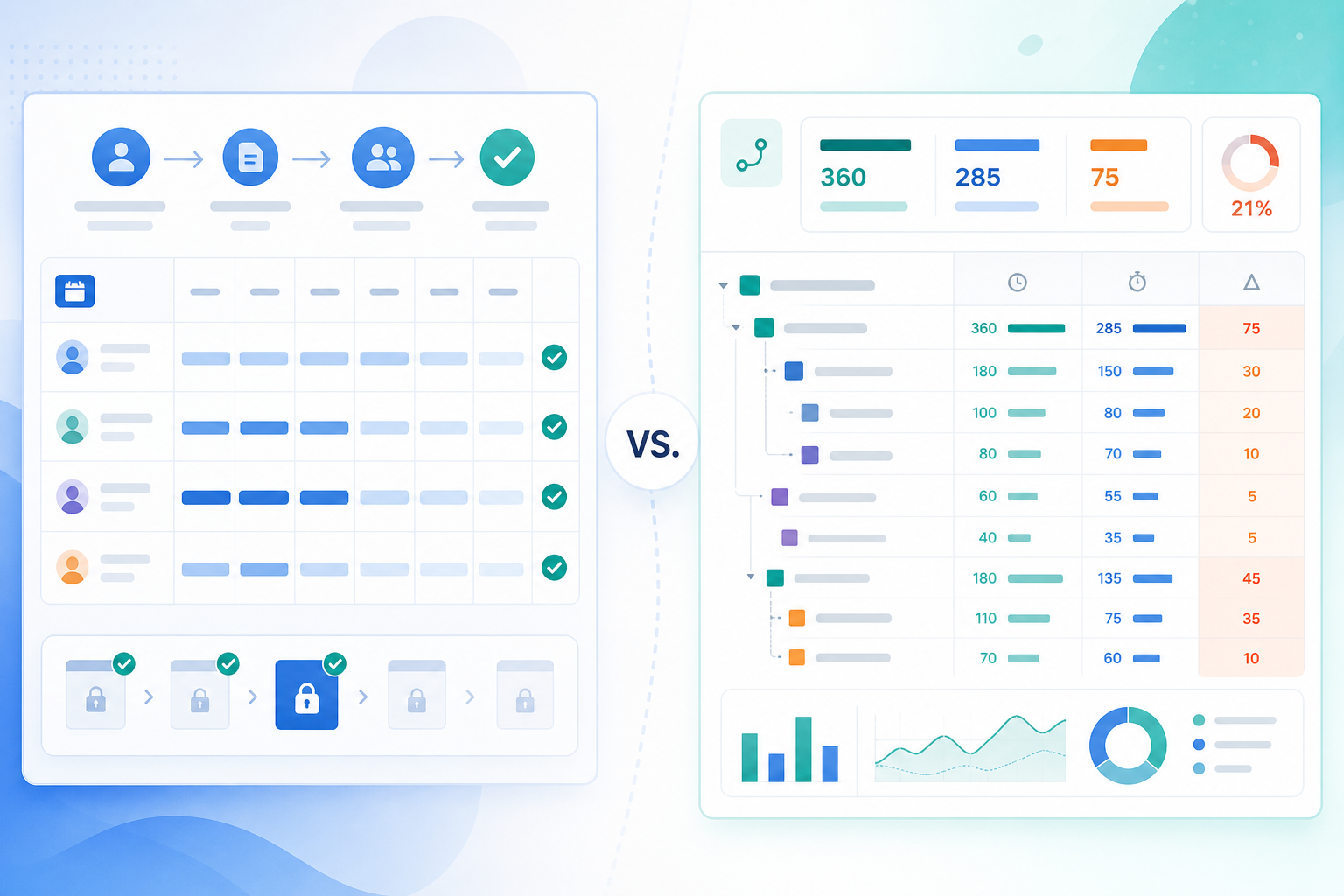
The evaluation meeting usually starts with one app name and two different problems.
Finance wants Tempo Timesheets because week-ending hours must be submitted, approved, and locked before invoicing. The delivery lead wants epic DEL-20 to show 120 hours estimated, 94 logged, and a child-issue breakdown for tomorrow's steering deck — without exporting to Excel again.
Both searches return "time tracking." Both listings mention worklogs and reports.
They are not the same buying decision.
Tempo timesheet Jira shortlists often treat the largest suite as the safe default. That can be correct when governance is the gap. It adds process and admin work when the only recurring pain is hierarchy rollup math on native Jira worklogs.
This comparison separates full-suite timesheet workflows from lightweight epic and parent rollups. Tempo is stronger where organizational time governance matters. A lighter Jira time rollup app may be enough when teams already log correctly and the project manager keeps rebuilding the same totals.
This is a use-case comparison, not a ranking.
Two Questions Behind Every Tempo Evaluation
Before opening Marketplace tabs, write the recurring report question.
Timesheet governance question:
"Who submitted time this period, who approved it, and can we lock the period before billing?"
Hierarchy rollup question:
"For this epic or project, what did we estimate, what have we logged, where is the variance, and which child issues explain it?"
Tempo Timesheets is built around the first question. Rollup-focused apps such as TimePillar are built around the second.
Quick decision flow:
- If approvals or period locks are required → start with timesheet category (Tempo is the common example).
- If the pain is manual epic/project totals with no approval need → evaluate rollup category first.
- If both apply → confirm Tempo's reports satisfy delivery rollup meetings before assuming one install covers both jobs; you may need Tempo plus a rollup view.
- If the question is workflow aging, not hours logged → neither category may fit; see status-analytics tools instead.
See Jira timesheets vs Jira time tracking for the broader category map.
Quick Comparison
| Dimension | Tempo Timesheets | Lighter rollup tool (e.g. TimePillar) |
|---|---|---|
| Primary job | Organization-wide timesheets and time governance | Live epic/project estimate vs logged rollup |
| Best when | Approvals, accounts, billing adjacency, team reporting | PM needs current hierarchy totals and exports |
| Typical buyer | Finance, PMO, ops | Project managers, delivery leads, scrum masters |
| Process change | Higher — submission and approval culture | Lower — reads existing Jira worklogs |
| Accounts and billing | Tempo Accounts and billable reporting in platform docs | Not a billing or period-lock tool |
| Integrations | Calendars, Tempo ecosystem, broader capture workflows per listing | Assumes logging already happens in Jira |
| Admin setup | Permissions, teams, accounts, Tempo Core | Lower; verify hierarchy rules and permissions |
| Not the main fit | Rollup-only pain with no approval need | Period locks, billable rates, payroll integration |
What Tempo Timesheets Is For
Tempo Timesheets is a long-standing Atlassian Marketplace timesheets option for organization-wide time governance.
At the time of prior verified research on this site (June 2026), the Tempo Cloud listing showed Cloud Fortified status, Marketplace Bug Bounty participation, and a large install count. Verify current pricing, hosting tabs, and edition requirements before procurement — this run did not re-fetch live Marketplace pages.
Tempo's public documentation and Help Center describe:
- Timesheet submission and approval workflows, including closed periods that prevent retroactive worklog edits after approval
- Tempo Accounts and billable vs non-billable reporting
- Team, project, and permission models beyond native Jira defaults
- Reports grouped by user, work item, account, and team
- Calendar integrations and Tempo platform workflows on the Marketplace listing
- Installation that requires Tempo Timesheets plus the free Tempo Core companion app
Tempo is stronger when the organization is ready to change how time is submitted, reviewed, and reported — not just how a project manager reads totals on an epic.
That strength comes with admin surface area. Financial or capacity views may require additional Tempo products beyond the base timesheet install — confirm on current Tempo pricing and docs.
Tempo can report across users and work items, but delivery leads should still validate whether Tempo's report shapes give the epic-level child breakdown they send to clients. Organizational reporting and explainable epic rollups are related jobs, not always the same screen.
What a Lighter Rollup Tool Is For
A lightweight rollup app targets the reporting gap after teams log time natively in Jira.
The recurring pain looks like this:
- Worklogs exist on stories and subtasks
- The epic or project parent does not show a defended total in one screen
- Someone exports search results and rebuilds variance in a spreadsheet before every review
Rollup tools — TimePillar is the named example on this site — position themselves as live views on the Jira issue screen that aggregate native time fields across child work.
Public TimePillar Marketplace and product materials describe project and epic rollups of estimated vs logged time, variance, percent of budget used, child-work visibility, and PDF/CSV export. The vendor claims zero configuration and that the app reads native Jira time fields without a separate data store — verify behavior in trial.
Prior research noted the Marketplace listing showed Jira Cloud while the product page also mentions Data Center. Verify your hosting path before rollout.
That category does not replace timesheet approvals, Tempo Accounts, billing period locks, payroll integrations, or calendar-based capture. It reduces manual rollup loops for delivery reporting.
Reporting Comparison
Tempo reports excel at organizational slices: by person, team, account, period, and work item across the timesheet workflow. Planned-vs-actual and financial views may live in separate Tempo products — confirm before procurement.
Rollup tools excel at delivery-scope slices: one epic, one project, one parent hierarchy with child-issue explanation. TimePillar's public materials emphasize estimate, logged time, and spent variance in the issue sidebar — not organization-wide timesheet submission.
If your stakeholder asks "which developers logged time on client X this week and were those hours approved," Tempo is the natural direction.
If your stakeholder asks "are we still inside the 120-hour epic estimate and which stories drove the overrun," a rollup tool may answer faster with less rollout.
One caution for rollup buyers: prior public-source review on this site did not find evidence that TimePillar rolls up remaining estimate for forecast variance. If your process depends on remaining estimate at parent scope, verify in trial.
Admin and Rollout Comparison
Tempo rollout typically includes:
- Tempo Core companion app installation
- Permission design across global, project, and team roles
- Account and team structure if finance uses Tempo Accounts
- Approval workflow design and period-close rules
- User training on timesheet submission habits
Rollup app rollout may require less process design, but admins should still verify:
- Which hierarchy levels roll up
- Rules when parent and child estimates are both populated — see original estimate vs time spent in Jira
- Permission behavior for viewers who cannot open every child issue
- Performance on large epics or projects
- Export format quality for stakeholder meetings
Atlassian's time tracking administration documentation notes that third-party time tracking providers may store data with the app developer. Review Marketplace Privacy & Security tabs for both finalists.
Where Tempo Is Clearly Stronger
Be direct about Tempo's advantages:
- Timesheet submission and approval — Tempo docs describe closing periods so worklogs cannot change after approval. Rollup tools do not substitute for that governance.
- Accounts and billable reporting — Tempo's platform targets billable vs non-billable organization reporting. Rollup tools focus on estimate vs logged delivery variance.
- Integrations and capture — Tempo's Marketplace positioning includes calendar integrations, automated suggestions, and broader Tempo ecosystem workflows. Rollup tools assume logging already happens in Jira.
- Organizational reporting — Tempo reports across people and periods. Rollup tools optimize one hierarchy scope at a time.
- Marketplace maturity signals — At prior research, Tempo showed long Marketplace presence, Cloud Fortified, and Bug Bounty participation. That supports procurement diligence; it does not mean every team needs the full suite.
Where a Lighter Rollup Tool May Be Enough
A rollup app may be sufficient when:
- Teams log time on issues today and finance does not require Tempo-style approvals
- The recurring report is estimate, logged time, variance, and child breakdown at epic or project scope
- Stakeholder exports feed sprint reviews or client updates, not payroll
- Admins want minimal change to how developers log work
- Jira search export math is accurate but too slow to repeat every cycle
That pattern appears across this site's rollup articles — see Why Jira worklogs look complete until you try to roll them up and Jira Plans rollups vs project reporting.
TimePillar fits this narrow job according to public vendor materials. It is not a substitute for Tempo when the gap is governance.
Marketplace and Security Notes
Treat Marketplace metadata as time-sensitive. At prior verified research (June 2026):
- Tempo showed Cloud Fortified, Bug Bounty participation, and a large Cloud install count
- TimePillar showed Runs on Atlassian, Partner Supported, a small install count, and no reviews yet
Install counts indicate category establishment, not fit. Trial on real data matters more than install signals alone.
For security review:
- Read Marketplace Privacy & Security tabs and vendor privacy policies
- Confirm whether the app becomes the time tracking provider or reads native worklogs
- Check data storage statements — TimePillar's product page claims no separate data store; treat as a vendor claim to verify
- Do not treat Cloud Fortified or Bug Bounty as compliance guarantees
See Before you install a Jira time tracking app, ask these 12 questions for a fuller pre-install checklist.
Common Misfits
Tempo for rollup-only pain
Symptom: PM exports child worklogs weekly; no approval or billing requirement.
Risk: months of Tempo permissions, accounts, and training for a report that needed hierarchy math.
Rollup tool for billing pain
Symptom: finance needs locked periods and billable rates; PM also needs epic totals.
Risk: rollup visibility without approval trails — possibly Tempo or two categories, not rollup alone.
Assuming Tempo reports replace epic explanation
Tempo can report across work items and users. Confirm report shapes match the client-facing epic breakdown before assuming one install covers both organizational and delivery rollup meetings.
What to Verify in a Trial
Tempo Timesheets
- Tempo Core installation and permission model
- Submission and approval workflow for a real team
- Period close behavior and retroactive edit rules
- Accounts, billable flags, and integrations finance needs
- Which Tempo products cover planned-vs-actual or financial reports
- Report exports for stakeholder questions — including epic-level breakdown if delivery leads attend the same meetings
- Current pricing, hosting tab (Cloud vs Data Center), and edition requirements
Lighter rollup tool
- Hierarchy coverage for your epics, stories, tasks, and subtasks
- Estimate, logged time, and variance on your real parent issues
- Parent vs child estimate rules — avoid double counting
- Remaining estimate support if forecast variance matters
- Permission behavior for non-admin viewers
- PDF/CSV export quality without cleanup
- Performance on your largest project
- Hosting model match (Cloud vs Data Center)
Recommendation by Use Case
Choose Tempo Timesheets when the recurring question is:
"Can employees submit timesheets, can managers approve them, and can finance report billable time by account and period?"
Choose a lighter rollup tool such as TimePillar when the recurring question is:
"Can I open this epic or project and see current estimate, logged time, variance, child breakdown, and export — without rebuilding a spreadsheet first?"
Run both evaluation tracks when finance needs Tempo governance and delivery leads still export epic totals manually — but confirm Tempo's reports satisfy the rollup meeting before adding a second app.
For broader Marketplace context beyond Tempo, see TimePillar vs Jira time tracking Marketplace apps.
Start With the Report, Not the Brand Name
Tempo Timesheets is the right direction when organizational time governance is the gap — approvals, accounts, period control, and team-scale reporting.
A lighter Jira time rollup app may be enough when native worklogs are fine and the pain is explainable epic or project totals for delivery meetings.
Name the recurring report. Match the category. Trial Tempo when process change is acceptable. Trial a rollup tool when the spreadsheet rebuild is the problem Tempo was never meant to solve alone.