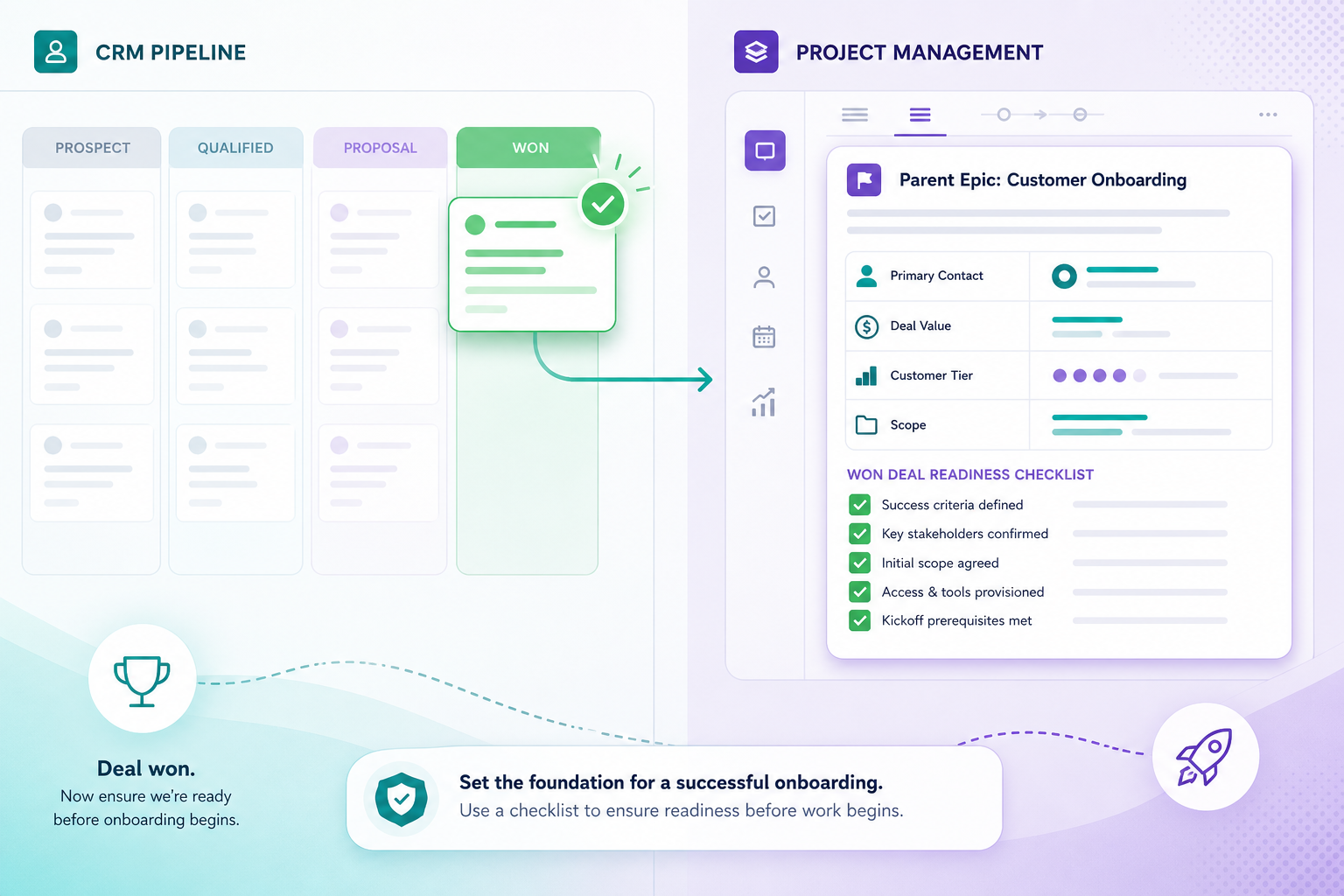
The Slack message lands before anyone opens Jira.
Sales marks the deal Won in Pipedrive at 4:30 p.m. By 4:35, implementation hears: "Kickoff is Monday — please get the onboarding epic ready." Monday arrives. The tech lead opens Jira, finds no parent epic, no assignee, and a description that says "Acme onboarding" with no package tier, no primary contact email, and no link back to the CRM record.
The deal closed. Onboarding started. The Pipedrive deal won Jira workflow never ran — because there was no workflow, only a status change.
"I can't kick off until I know which tier they bought — and I don't see it anywhere in Jira."
That message from an implementation manager is the symptom. The cause is missing readiness rules between Won in CRM and work in Jira.
Won Is a Trigger, Not a Handoff
Marking a deal Won in Pipedrive is a sales milestone. It is not, by itself, a Pipedrive implementation handoff.
Pipedrive's deal documentation treats deals as pipeline objects with value, stage, person, organization, owner, and history. Won means revenue closed in CRM terms. Delivery teams need something different: a Jira artifact with scope, contacts, commercial context, and an owner — ready before sprint planning, not after a Slack reminder.
Some teams start delivery at a named pipeline stage — "Contract signed" or "Handoff ready" — rather than at Won. That is valid when legal or finance marks revenue later. The checklist below still applies; only the trigger event changes.
The Readiness Gate
Before onboarding kickoff, agree a readiness gate — conditions that must be true in both systems before delivery accepts the deal.
For agencies and SaaS implementation teams, a workable gate includes:
- Sales completeness — required Pipedrive custom fields populated; primary contact confirmed; latest scope note on the deal as an activity.
- Commercial alignment — deal value matches signed scope; post-demo revisions reflected in CRM.
- Jira existence — parent onboarding epic or issue in the agreed project with mapped fields.
- Ownership — assignee or queue named; handoff verifier signed off.
- Reverse path defined — how Jira progress reaches sales — activity sync, status summary, or standing meeting.
If step three is missing, you do not have a won deal onboarding Jira process — you have a calendar invite.
Who owns what
| Role | Owns |
|---|---|
| Sales owner | Field completeness in Pipedrive before the trigger; scope notes on the deal |
| Handoff verifier | Confirms CRM record matches signed scope before delivery accepts |
| Implementation lead | Accepts Jira artifact; schedules kickoff; assigns delivery team |
| Jira admin | Project templates, permissions, automation rules, webhook health |
Ambiguity here produces the classic pattern: Won in CRM, empty ticket in Jira, and a meeting to copy fields manually.
Checklist: Pipedrive Before Delivery Accepts the Deal
Sales should not release a deal to onboarding until these are present. Adjust field names to your account.
| Field / record | Why delivery needs it before kickoff |
|---|---|
| Deal title (customer + project name) | Becomes Jira summary |
| Deal value + currency | Budget and scope conversations |
| Organization + contact person | Day-one emails and access requests |
| Sales owner | Escalation when scope is unclear |
| Package / tier custom field | Prevents "which SKU did they buy?" in week two |
| Integration or SLA custom fields | Technical onboarding dependencies |
| Region, timezone, or language | Scheduling and staffing |
| Latest activity note from solution call | Pre-sale commitments beyond title |
| Source / label | Segmentation and reporting |
| Expected start or close date | Milestone planning |
A Won deal with empty activities and missing custom fields is a common source of Pipedrive implementation handoff delays — especially when multiple implementations run in parallel.
Checklist: What Must Exist in Jira Before Onboarding Starts
When the readiness gate passes, Jira should contain at minimum:
- Parent work item — onboarding epic, implementation story, or service request in the agreed project and issue type.
- Summary — customer and project identity matching the deal title.
- Commercial context — value, currency, and package tier in description or searchable custom fields.
- Contact block — primary stakeholder name, organization, and reachable email.
- Sales owner reference — who sold it and who clarifies scope.
- Scope note — latest pre-sale commitment text, not a one-line placeholder.
- Assignee or queue — unowned onboarding epics stall before day one.
- Labels or components — product line, region, or onboarding template identifier.
- Link or traceability — deal ID, CRM URL, or integration link so delivery can return to Pipedrive.
- Child template stub — optional subtasks for access, kickoff, configuration, and UAT if your team uses a standard onboarding breakdown.
This is the deal closed delivery start baseline. Anything less forces implementation managers to reconstruct CRM context during kickoff.
What the first onboarding epic should look like
Illustrative shape only — your template may differ:
Summary: Acme Corp — Enterprise onboarding
Description sections:
- Value: USD 56,000
- Package tier: Integration Pro (Pipedrive custom field)
- Contact: Jane Doe, jane@acme.com (Acme Corp)
- Sales owner: Alex
- Scope note: "SSO + sandbox by week 2; 40 seats"
- CRM: Pipedrive deal #4821
- Target kickoff: 2026-07-08
If your first Jira issue stops at title and value, onboarding has not actually started — CRM context is still locked in Pipedrive.
Eight Questions to Ask Before Won Becomes a Jira Ticket
Use these in a buyer or process workshop before you rely on manual paste or automation:
- Which event starts delivery work? Deal won, a named stage, or human approval after Won?
- What is the minimum Pipedrive field list sales must complete before that event?
- Which Jira project and issue type receive every new onboarding handoff?
- Who verifies the handoff before the implementation lead schedules kickoff?
- What must appear in Jira custom fields vs description text for reporting?
- How do post-handoff CRM changes reach delivery — comments, live panel, or manual updates?
- How does Jira progress reach sales — Pipedrive activity, email, or status meetings?
- What is the fallback when automation or webhooks fail?
Teams that cannot answer question eight still have a manual handoff — regardless of tooling plans.
Ad-Hoc Handoff vs Structured Won-Deal Workflow
| Element | Ad-hoc (Slack + manual Jira) | Structured won-deal workflow |
|---|---|---|
| Timing | After Won, when someone remembers | Defined gate before delivery accepts |
| Jira creation | Manual, inconsistent | Template or automation at agreed trigger |
| Field coverage | Title and value only | Minimum field list enforced |
| CRM link | Often missing | Deal ID or live panel on issue |
| Post-won CRM changes | Lost unless re-communicated | Comments, panel refresh, or sync if configured |
| Sales visibility | Status meetings | Pipedrive activity from Jira status if enabled |
| Failure mode | Gaps found in sprint planning | Checklist or automation health dashboard |
Pattern comparison, not a product ranking. Manual checklists work at low volume if enforced consistently.
What Goes Wrong When Jira Starts Empty
Agency pattern. Three client onboardings start the same week. Two epics include tier and contact blocks; the third was created from a Slack one-liner. The third client sends the first support escalation because SSO scope was never copied from Pipedrive.
SaaS implementation pattern. Customer success marks the deal Won after verbal commit. Engineering pulls a placeholder epic into sprint planning without integration SKU. Mid-sprint discovery sends the team back to sales for scope clarification — burning a week of capacity.
Agency and SaaS Handoff Variations
The same won-deal gate needs slightly different emphasis by delivery model.
| Delivery model | Extra fields to verify before Jira starts | Jira artifact shape |
|---|---|---|
| SaaS implementation | Plan/tier, integration SKU, seat count, environment, SSO or security requirements, target go-live | Implementation epic with configuration, access, training, and UAT child work |
| Agency onboarding | Client stakeholders, approved scope, creative or technical deliverables, kickoff date, retainer/project value | Client onboarding epic or project board with discovery, production, review, and launch tasks |
| Technical services | Platform constraints, integration endpoints, SLA, support handoff, data migration notes | Delivery epic with architecture, build, QA, deployment, and support transition |
Do not create separate workflows just because the vertical changes. Keep the gate consistent: complete CRM fields, one owned Jira parent, traceability back to Pipedrive, and a documented path for post-won changes.
Common root causes:
- Integration tier sits in a Pipedrive custom field never mapped into Jira
- Primary stakeholder changed after demo; Jira still shows the old contact
- Unowned epic sits in backlog until someone escalates
- Deal value revised after scope add-on; Jira description shows the original number
- Sales asks "where are we?" because Jira status never reaches Pipedrive
These failures are visible at won deal onboarding Jira scale. They are process gaps, not sprint execution problems.
Do Not Schedule Kickoff Until Jira Passes Review
Add an explicit rule for implementation managers:
Do not schedule customer kickoff and do not pull onboarding work into sprint planning until the Jira parent issue passes the ten-item checklist above.
That single gate prevents the most expensive failure mode: customer-facing meetings that begin before internal scope is written down.
When Won-Deal Automation Is Worth Configuring
| Signal | Manual checklist may suffice | Consider automation |
|---|---|---|
| Deal volume | Few wins per month | Weekly wins or faster |
| Field complexity | Title, value, contact only | Multiple custom fields every time |
| Error rate | Rare paste mistakes | Repeated kickoff surprises |
| Change rate after Won | Low | Frequent value or scope revisions |
| Admin capacity | Someone owns manual verification | Jira admin can monitor webhook health |
Automation without a minimum field list still creates thin tickets. Write the checklist first; automate second.
Backlog Bridge's public Pipedrive Integration for Jira product page describes won-deal triggers, pre-filled issue content, live deal panels, and two-way status signals. Treat that as a hypothesis to verify in sandbox — not a substitute for the readiness gate above.
For step-by-step configuration, see How to Auto-Create Jira Issues from Pipedrive Deals.
What Jira Admins Should Verify Before Won-Deal Automation
Connecting CRM data to Jira is an admin decision:
- Trigger rule matches sales process — Won only, or a named stage before Won?
- Minimum fields mapped into summary, description, and any Jira custom fields delivery filters on
- Target project and issue type match the onboarding template
- Duplicate behavior when the same deal fires twice or webhooks retry
- Webhook health visible when events stop — Pipedrive webhooks must reach your endpoint
- Permissions — which Jira users can see deal value and contacts on issues?
- Token custody — Pipedrive API token rotation and least-privilege scope
- Data handling — read vendor privacy statements and Marketplace security materials if procurement requires them
No Atlassian Marketplace listing URL was provided in editorial metadata for this article, and listing details were not verified at the time of writing (July 2026). Search Marketplace for the app name and verify current pricing, hosting, scopes, and privacy tabs before installation.
Do not treat vendor marketing copy as procurement evidence. Confirm behavior with reproducible test deals.
Master Checklist: Before Onboarding Starts
Copy this into your runbook:
In Pipedrive (sales-owned)
- [ ] Required custom fields complete
- [ ] Primary contact and organization confirmed
- [ ] Latest scope note on deal activities
- [ ] Deal value matches signed scope
- [ ] Trigger event agreed (Won or named stage)
In Jira (delivery-owned)
- [ ] Parent onboarding issue exists in correct project
- [ ] Summary, commercial context, and contact block present
- [ ] Assignee or queue named
- [ ] Scope note and CRM traceability included
- [ ] Handoff verifier signed off
People and process
- [ ] Kickoff not scheduled until Jira passes review
- [ ] Reverse path to sales defined
- [ ] Fallback documented if automation fails
Run the Checklist Before the Next Won Deal
Pipedrive deal won Jira workflow success is not about moving faster on Monday. It is about knowing what must be true in CRM and Jira before onboarding is allowed to start.
Write the readiness gate. Publish the minimum field list. Name the handoff owner. Create the first Jira artifact with scope, contacts, and assignee — manually or by automation — then verify in trial if you connect Pipedrive to Jira.
That is how deal closed delivery start stops meaning "someone will paste the deal eventually."
See how Pipedrive Integration for Jira approaches won-deal triggers, pre-filled onboarding issues, and live deal context for teams ready to test structured handoffs.
For why context disappears between systems, read The Sales-to-Delivery Handoff Gap.