The RevOps lead and the Jira admin sat in the same evaluation with different success criteria.
The admin wanted deal stage changed Jira rules that delivery could trust — with live CRM context inside every linked issue and webhook health visible in Jira admin, not buried in another dashboard. RevOps already ran Relay.app playbooks for lead routing, contract reminders, and a handful of CRM-adjacent automations the whole revenue team could see and share.
"We already build handoffs in Relay — why install another Jira app?"
Because the two options optimize for different centers of gravity. One is a Jira-native handoff product. The other is a collaborative automation platform where playbooks live outside Jira. This Pipedrive Jira Relay alternative comparison is about which job you are hiring software to do — not which brand wins a feature checklist.
The question was not "can Relay connect Pipedrive and Jira?" It was whether Relay Pipedrive Jira playbooks should be your primary sales handoff automation path, or whether a packaged native Jira Pipedrive app removes more manual work for the teams who actually live in Jira every day.
Quick Decision Flow
- If delivery teams need live CRM context inside the Jira issue view and Jira admins want webhook health in Jira admin → evaluate Pipedrive Integration for Jira (Forge app).
- If the team already standardizes on Relay.app, wants shared playbooks with optional human review, and can accept external configuration and monitoring → evaluate Relay Pipedrive Jira playbooks first.
- If you have no existing Relay practice and no owner for playbook maintenance → evaluate the Forge app or a simpler iPaaS before adopting another automation platform. See Pipedrive Jira Integration: Native Forge App vs Zapier or Building Pipedrive–Jira Sync with n8n vs Installing a Jira Marketplace App.
- If deal volume is low or requirements are unusual → tighten manual handoff before buying either path. See The Sales-to-Delivery Handoff Gap.
This is a comparison by workflow, not a ranking.
Start With the Handoff Job
Before comparing products, write the question your team needs answered:
"When a deal is won — or reaches our handoff stage — what must happen in Jira, and who needs to see CRM context afterward?"
| If the recurring question is… | You are optimizing for… |
|---|---|
| "Create the right Jira epic with the right fields every time" | Reliable deal→issue creation |
| "Why does the Jira description still show last week's deal value?" | Live CRM context inside Jira |
| "Sales keeps asking for status — can Jira update Pipedrive?" | Reverse visibility to CRM |
| "Automation is on — why didn't the epic appear?" | Observable webhook or playbook health |
| "Ops wants to approve handoffs before Jira work exists" | Human-in-the-loop automation |
| "We need this workflow to also notify Slack and update a spreadsheet" | Cross-app orchestration in one platform |
Different answers point to different tooling. The Forge app is positioned around the first four rows. Relay is strongest when the fifth and sixth rows matter as much as CRM↔Jira sync.
Platform facts both paths share: Pipedrive documents webhooks for deal change events. Jira Cloud's REST API supports creating issues and adding comments. Neither Pipedrive nor Jira natively bridges the other — an app, playbook platform, or custom middleware sits in the middle.
What the Native Forge App Is
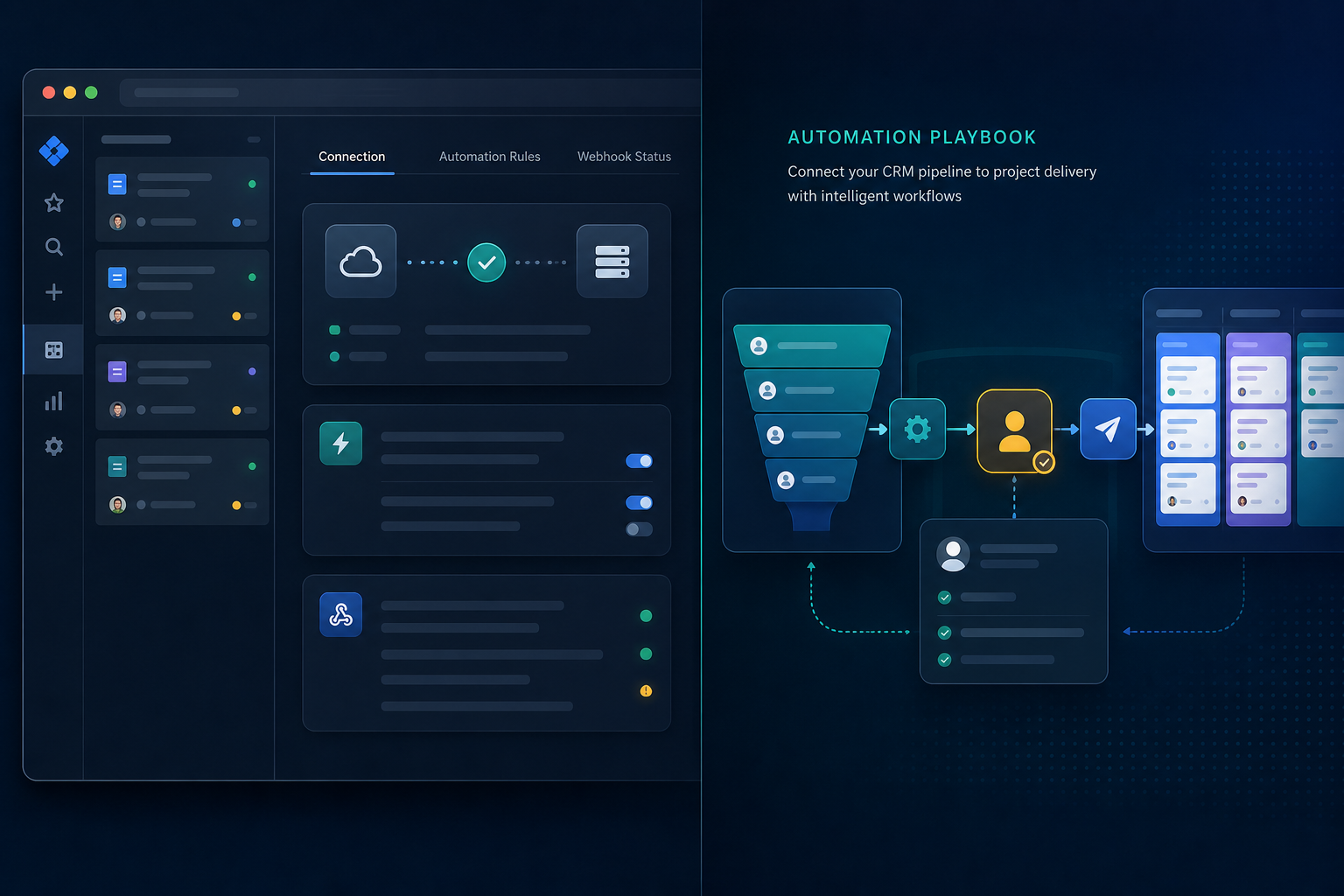
Pipedrive Integration for Jira by Backlog Bridge is described on the public product page as a Jira Cloud integration configured through three admin tabs:
- Connection — Pipedrive company domain and API token shared across rules
- Automation Rules — trigger on deal created, pipeline stage reached, or deal won; target Jira project, issue type, and selected field mapping
- Webhook & Status — register the Pipedrive webhook and monitor health indicators
Vendor copy also describes:
- Auto-created Jira issues pre-filled with deal title, value, currency, stage, close date, contact, owner, source, labels, latest activity note, and selected custom fields
- A live Pipedrive panel in the Jira issue sidebar — deal data fetched when the issue is opened per vendor description
- Jira status changes logged as Pipedrive activities on linked deals
- Pipedrive deal updates posted as Jira comments on linked issues
That pattern maps to a purpose-built native Jira Pipedrive app: configuration, monitoring, and contextual CRM UI live inside Jira admin and the issue view. Treat every vendor claim as a sandbox trial hypothesis — not procurement evidence.
No Atlassian Marketplace listing URL was provided in editorial metadata for this article, and listing details were not verified at the time of writing (July 2026). Search Marketplace for the app name and verify current pricing, hosting, scopes, and privacy tabs before installation.
What Relay.app Is in This Context
Relay.app is a collaborative workflow automation platform. You build playbooks in the Relay web UI: a Pipedrive trigger and Jira actions (for example, create issue, update issue, or add comment), optionally with branching, filters, and steps in other apps.
Relay connects apps without installing a Jira Marketplace product. Pipedrive and Jira are both supported on Relay's platform. Exact trigger names, action fields, filter options, and plan limits were not verified in this research run — verify the current integration catalog on relay.app before designing production playbooks. Topic guidance for this article was to research Relay trigger examples cautiously; treat illustrative patterns below as trial hypotheses.
Typical Relay Pipedrive Jira patterns teams search for:
- Create Jira issue when a deal moves to a stage or is marked won
- Add Jira comment when deal value or owner changes
- Separate playbook with Jira trigger → Pipedrive action for reverse updates
- Human review or approval step before issue creation when ops wants a gate on handoff quality — verify whether your Relay plan includes human-in-the-loop steps today
Relay strengths for this use case: shared playbooks visible to RevOps and sales ops, branching logic, multi-app orchestration in one automation, and platform positioning around collaborative automation rather than solo builder workflows. Relay trade-offs: configuration and error history live in Relay, not Jira admin; there is no vendor-described live CRM sidebar inside the Jira issue view; two-way sync usually means multiple playbooks and explicit deduplication design.
"The playbook looks perfect in Relay — but delivery still opens Pipedrive in a second tab."
That complaint usually means the team solved create-time automation without solving week-two context inside Jira — a gap the Forge app's live panel claim targets. See Why Delivery Teams Need a Live Pipedrive Panel Inside Every Jira Issue.
Playbooks vs Admin-Native Rules
The structural difference is where sales handoff automation lives after procurement.
| Aspect | Forge app | Relay.app |
|---|---|---|
| Rule ownership | Jira admin tabs | Relay playbook editor |
| Who edits triggers | Jira administrator | RevOps / automation owner with Relay access |
| Visibility to delivery | Issue panel + Jira fields/comments | Jira fields/comments only (unless you add separate UI) |
| Sharing model | Jira project permissions | Relay workspace / playbook sharing — verify current product behavior |
| Best when ops center is… | Jira | Revenue operations platform |
Neither model is inherently better. The fit question is whether your organization wants handoff logic inside Jira admin or inside a shared automation catalog RevOps already maintains.
Quick Comparison
| Dimension | Pipedrive Integration for Jira (Forge) | Relay.app |
|---|---|---|
| Configuration location | Jira admin tabs | Relay playbook UI |
| Primary fit | Pipedrive↔Jira handoff inside Jira | Collaborative multi-app playbooks |
| Live deal panel in issue view | Vendor claims sidebar panel — verify in trial | Not native; comments/fields only |
| Forward automation health | Vendor claims Webhook & Status dashboard in Jira admin | Run history and alerts in Relay |
| Two-way sync | Vendor describes built-in status→activity and deal→comment paths | Typically multiple playbooks + maintenance |
| Human review before Jira create | Not a marketed Forge feature | Platform may support human-in-the-loop — verify plans |
| Cross-app orchestration | Focused on CRM↔Jira | Strong — Slack, sheets, email, etc. in same playbook |
| Credential model | Pipedrive token in Jira Connection tab | Separate Pipedrive and Jira connections in Relay |
| Pricing model | App/Marketplace pricing — verify manually | Step/run-based — verify relay.app plans |
| Jira install required | Yes — Forge app install path | No Jira app; OAuth/API via Relay |
| Typical owner | Jira admin / ops | RevOps / sales ops |
Feature Comparison
Deal stage changed → Jira issue creation
Both paths can react when a Pipedrive deal changes pipeline stage — the common deal stage changed Jira evaluation scenario.
The Forge app routes events through vendor-described webhook processing and Automation Rules — see Which Pipedrive Pipeline Stage Should Trigger Jira Issue Creation? and How to Auto-Create Jira Issues from Pipedrive Deals. Relay maps trigger payload fields to the Jira create-issue action field by field in a playbook.
Where the Forge app may fit better: handoff defaults — linked records, field checklist oriented to onboarding epics, and admin UI aimed at Jira owners rather than RevOps builders.
Where Relay may fit better: non-standard logic — branch on custom field values, fan out to Slack and Google Sheets in the same automation, or combine Pipedrive with apps the Forge product does not touch.
Live deal context after handoff day
Copy-paste descriptions go stale. Week-two value revisions and contact swaps are the everyday failure mode.
Vendor copy describes a Forge issue panel that fetches current deal data when a linked issue is opened. Relay can write Jira comments or update fields when deals change — see When a Pipedrive Deal Changes, Should Jira Get a Comment or a Field Update? — but it does not render live CRM UI inside the Jira sidebar.
If "open Jira and see current deal value without opening Pipedrive" is a hard requirement, weigh the Forge panel claim heavily in trial. If occasional comment updates are enough, Relay may suffice.
Reverse visibility to sales
Vendor copy describes Jira status transitions creating Pipedrive activities automatically. Relay can approximate this with a Jira trigger playbook and Pipedrive create-activity action — see Sync Jira Status Changes Back to Pipedrive for the workflow design questions.
The difference is packaging versus assembly. The Forge app vendor story is bidirectional sync in one product. Relay's story is "you can build it" — often as separate playbooks with filters to control noise and duplicates.
Human review and playbook visibility
Some teams want sales handoff automation that pauses before Jira work exists — for example, when implementation managers must confirm capacity or required CRM fields are complete.
Relay's platform positioning emphasizes collaborative playbooks and optional human steps in workflows. Whether that fits your handoff gate depends on current Relay plan features and how your RevOps team already uses the product — verify in trial rather than assuming every plan includes approval steps.
The Forge app vendor story centers on automatic issue creation when configured triggers fire. If you need a human gate, you either enforce it in Pipedrive (stage discipline, required fields) or use an external playbook tool — which may point toward Relay if you already pay for it.
Failure detection
Silent webhook failure is the common forward-path outage — see Pipedrive Webhooks for Jira: An Admin Setup Checklist. Vendor copy describes last event received, last processed deal, and last created issue on a Jira admin tab.
Relay exposes failed runs in playbook history and optional email or Slack notifications. That helps — if someone with Relay access monitors it. Jira admins who do not log into Relay may learn about failures from sales before automation owners do.
Admin, Setup, and Maintenance
| Admin task | Forge app | Relay.app |
|---|---|---|
| Initial install | Jira app install — verify Marketplace or vendor path | Connect Pipedrive + Jira accounts in Relay |
| Pipedrive API token | Jira admin Connection tab | Relay Pipedrive connection |
| Webhook registration | Vendor describes one-click from Jira admin | Managed by Relay trigger subscription |
| Rule changes | Edit Automation Rules in Jira admin | Edit playbook steps in Relay UI |
| Token rotation | Update Connection tab same day — see Pipedrive API Tokens and Jira Admins | Update Relay connection; test playbook |
| Pipeline or field changes | Re-verify rules and mappings in Jira admin | Edit field mapping in each affected playbook |
| Monitoring owner | Jira admin / ops | RevOps or automation owner with Relay access |
| Sandbox validation | Test deals + Webhook & Status tab | Playbook test runs + run history |
Maintenance over time: sales teams rename pipeline stages, add custom fields, and rotate API tokens. On the Forge path, those changes point back to Jira admin tabs and the webhook checklist. On the Relay path, they point to playbook editor sessions and connection retests — possibly across multiple playbooks if you built reverse sync separately.
People cost: a packaged Jira app may reduce RevOps time to maintain playbooks; an existing Relay practice may make a new Jira app feel redundant — especially if RevOps already owns CRM automation and Jira admins only manage projects.
Pricing and Operational Cost
Neither pricing model was verified at the time of writing (July 2026). Do not treat prices as permanent.
Forge app: check Atlassian Marketplace or the vendor contact path for current subscription, trial, and user-tier pricing before procurement.
Relay.app: pricing is typically tied to automation usage — steps or runs depending on current plan structure on relay.app. A multi-step playbook (filter → create issue → Slack message) may consume more than one unit per deal event. High deal volume or frequent deal updates can make usage math material. Compare projected monthly usage against app subscription cost for your actual trigger frequency.
Also compare people cost: RevOps time to design and maintain playbooks versus Jira admin time to manage Automation Rules and webhook health.
Security and Privacy Notes
Both paths move CRM commercial data into Jira and may write delivery signals back to Pipedrive.
Verify before production on either path:
- Who can view deal value, contacts, and notes on Jira issues, comments, or panels?
- Where are Pipedrive and Jira credentials stored and who can rotate them?
- What privacy statements apply — Marketplace Privacy & Security tab, vendor policy, Relay data processing terms?
- Does your procurement process require Marketplace listing, DPA, or specific compliance badges — and does either path satisfy that today?
The Forge app setup requires a Pipedrive API token in Jira configuration per vendor copy. Relay stores connections in its platform and processes data during playbook runs. I did not verify SOC 2, GDPR, Cloud Fortified, or Bug Bounty claims for either path in this article. A human reviewer should verify before publishing procurement guidance.
Recommendation by Use Case
Evaluate the Forge app first when:
- Delivery teams need live Pipedrive context inside Jira issues, not only create-time description text
- Jira admins want forward webhook health visible in Jira admin, not only in an external dashboard
- The workflow center is deal → Jira work → sales visibility back with minimal cross-app branching
- Ops ownership sits with Jira administrators more than central RevOps
Evaluate Relay first when:
- The organization already standardizes automation on Relay.app and adding one CRM↔Jira playbook fits existing ops
- The workflow needs shared playbooks, optional human review before Jira creation, or custom multi-app orchestration in the same automation
- One-way or lightly designed two-way create/update behavior is enough — live in-Jira CRM panels are not required
- A RevOps or automation team already monitors playbook failures with discipline
The Forge app may be more than you need when:
- You only need a single create-issue playbook, already have Relay, and nobody requires in-Jira deal panels or Jira-side webhook dashboards
Relay may be insufficient when:
- Delivery's recurring pain is stale CRM snapshots in Jira and sales visibility depends on Jira-native context
- Jira admins need integration health inside admin and cannot rely on a separate Relay owner
- Reverse sync, deduplication, and comment noise require more design work than your team will maintain in multiple playbooks
- Nobody on staff will own Relay playbook health if RevOps turnover is high
Consider manual process or custom middleware when:
- Deal volume is low, or requirements exceed both packaged options — custom webhook endpoints offer control at higher build and monitoring cost
What to Verify Before Installing
Forge app trial checklist
- Trigger timing (created, stage, won) matches your sales process
- Custom Pipedrive fields map correctly into created issues
- Live panel shows the fields delivery uses in week two — not only at create
- Webhook & Status tab timestamps advance on sandbox deal tests
- Reverse activity logging noise level is acceptable to sales
- Jira permission boundaries match who should see commercial data
- Marketplace listing (if used) matches hosting, pricing, and privacy requirements
Relay trial checklist
- Current Pipedrive triggers and Jira actions on relay.app support your site and issue types — verify catalog, do not rely on article examples
- Field mapping covers required custom Pipedrive fields
- Two-way design handles duplicates on webhook or playbook retries
- Usage estimate fits budget at expected deal activity
- Error notifications reach an owner who will act before sales escalates
- Token rotation runbook updates Relay connections on the same schedule as CRM credential changes
- Human-in-the-loop steps (if required) exist on your plan and match handoff gate timing
Confirm behavior with reproducible sandbox deals — not slide-deck claims.
The Buying Question
The practical comparison is not Forge app vs Relay in the abstract.
It is the handoff product question versus the collaborative playbook platform question.
If the recurring pain is won deals arriving in Jira without context, stale commercial fields after handoff, and silent forward automation failures, a native Jira Pipedrive app with admin-side monitoring and an in-issue panel claim deserves a structured sandbox trial.
If the recurring pain is "connect these two systems in playbooks our RevOps team already shares," live CRM UI inside Jira is optional, and optional human review before issue creation matters, a Pipedrive Jira Relay alternative built as playbooks may be enough — provided someone owns playbook health, usage cost, and field mapping over time.
Write the handoff checklist first — trigger, minimum fields, change path, reverse path. Then choose the tool that removes the most manual work without creating a larger process than your team will actually maintain.
See how Pipedrive Integration for Jira approaches live deal context, trigger-based issue creation, webhook status monitoring, and two-way updates. For the process both paths must satisfy, read The Sales-to-Delivery Handoff Gap.